
Turn Frustration Into Focus to Get the Skills She Needs For Season
There’s no way around it—watching your gymnast struggle to get a skill she needs for competition season is hard. The closer the season gets, the more the frustration builds. You see it on her face after practice: that combination of exhaustion, disappointment, and self-doubt. You try to encourage her, but nothing seems to help. She keeps saying things like, “I just can’t do it,” or “Why is everyone else getting this skill but me?”
And as a parent, you’re stuck in a tough place. You want to help, but you don’t know how to solve a problem that seems so far beyond your control. It can feel helpless and frustrating for you, too. But here’s what I want you to know: this frustration she’s feeling? It’s completely normal. And it’s not a sign that she’s failing. In fact, it might just be the very thing that helps her level up in a way that will change the entire trajectory of her gymnastics career.
Gymnastics Progress is Not Linear
In gymnastics, we all tend to fall into this trap of believing that progress should be linear. Your gymnast starts learning a new skill, and at first, there’s some quick improvement—she’s starting to get the feel of it, and she’s excited by the prospect of mastering something new. But then, suddenly, things stop moving forward. She gets stuck, and that spark of excitement turns into frustration. She might even start avoiding the skill altogether, because every attempt just brings more of that feeling that she’s not good enough.
You might be thinking, “But she’s working so hard. Why isn’t she improving?” And that’s exactly the thing—sometimes, the harder she pushes, the more stuck she feels. It’s not because she isn’t capable. It’s because she’s human, and humans aren’t robots. Gymnasts are not immune to the normal challenges that come with learning something new, especially when the stakes are high, and they feel pressure to nail it before the season starts.
One gymnast I worked with, Lauren, was an absolute powerhouse in her level. She was always on top of her skills, rarely struggling to get anything new. But when she reached level 9, she hit a wall—specifically on her bail on bars. No matter how many times she tried, she couldn’t seem to get it consistently. And for the first time, she started to doubt herself. She’d be mad and moody after practices, she’d freeze before attempts, and her coaches started to get frustrated too. This was new territory for her and for her parents, who had always seen their daughter soar through each season with ease.
This is the part of gymnastics most people don’t talk about: the mental toll. The frustration that creeps in when progress isn’t happening as quickly as expected. The doubts that flood in, making your gymnast question her abilities. Lauren wasn’t just struggling with her release move; she was struggling with her own self-belief.
Why Frustration Can Be a Game-Changer
Frustration isn’t just a hurdle in gymnastics—it’s a sign that your gymnast is on the edge of something big. When a gymnast hits a wall, it’s often because they’re pushing their limits, both physically and mentally. That frustration means they’re being stretched in new ways, which is exactly what needs to happen for real growth to occur. If everything was always easy, how would your gymnast ever discover her true potential?
I’ve seen it time and again. Take Evelyn, a gymnast who came to us when she was struggling with balking on vault. It was the middle of season and she couldn’t get past her mental block. She was frustrated, her coaches were frustrated, and she was starting to feel like she’d never get there. But what Evelyn didn’t realize at the time was that this frustration wasn’t a roadblock—it was a signal. It was her body and mind telling her that she was on the verge of something new and challenging, and that with the right tools and mindset, she was going to break through.
Fast forward just 5 weeks, and not only did Evelyn get her vault back—she went on to compete successfully at state and regionals. And the best part? She learned how to handle frustration in a way that made her mentally tougher for every skill after that. Moving forward, when she felt frustration bubble up, she didn’t crumble. She leaned into it, knowing that it’s part of her growth process.
Frustration is often seen as the enemy, but in reality, it’s a clue. It’s telling your gymnast that she’s about to level up, but she needs to shift the way she approaches the challenge.
The Pressure Cooker of Pre-Season
So why does this frustration seem to hit hardest as competition season approaches? Because the stakes are higher. Your gymnast knows she needs this skill to compete at her best, and that pressure adds a whole new layer to the struggle. It’s not just about getting the skill anymore—it’s about proving to herself, her coaches, and her teammates that she belongs at this level.
And that’s where the real danger lies. When frustration builds alongside pressure, it can morph into something far more damaging: doubt. The longer your gymnast struggles without progress, the more she starts to question whether she’s good enough. Doubt creeps in and takes over, making her believe that maybe she just can’t do it. That maybe this is the skill that will keep her from reaching her goals.
Lauren, the gymnast I mentioned earlier, started to spiral into that doubt. She went from being a confident athlete to questioning everything about her ability to compete at her level. Her coaches were at a loss, and her parents were worried that she was losing her passion for the sport. But here’s what I told them: This struggle is exactly what she needs right now. It’s hard, it’s frustrating, and it’s uncomfortable, but it’s also the gateway to her next level of growth.
What’s Really Going On Behind the Struggle to Get (or Keep!) Her Skills.
Here’s the thing about gymnastics: the battle isn’t just physical. Sure, the skill might be difficult, and it might take some time to master the technique, but 9 times out of 10, the real struggle is happening in your gymnast’s mind.
When a gymnast is stuck on a skill, the frustration isn’t just about the mechanics of the move. It’s about the pressure, the fear, and the expectations she’s placed on herself. She’s not just frustrated because she’s not landing the skill—she’s frustrated because she believes that not getting the skill means something about her as a gymnast. She thinks it means she’s not good enough, or that she’s falling behind, or that everyone else is progressing except her.
But here’s what I want you and your gymnast to understand: that belief is a lie. The truth is, every gymnast struggles at some point. Every gymnast has moments where they feel stuck, where progress seems impossible, and where frustration feels overwhelming. But it’s what she does with that frustration that matters.
One of the most important things your gymnast can learn is that her worth isn’t tied to how quickly she masters a skill. She is not her skills. Her value as a gymnast—and as a person—doesn’t hinge on whether she can hit a release move or a dismount. When she can separate her self-worth from her performance, she’ll be freed up to focus on what really matters: improving, learning, and pushing her limits for the sake of growth, not because she’s trying to prove herself.
The Power of Frustration to Build Mental Resilience
What your gymnast is going through right now—the frustration, the struggle, the doubt—is building something far more valuable than any single skill. It’s building resilience. It’s teaching her how to handle challenges, how to work through obstacles, and how to keep going even when things feel hard.
One of the gymnasts I’ve worked with told me after finally mastering her beam series: “It wasn’t about getting the skill anymore. I learned how to trust myself, even when things weren’t going my way.” And that’s exactly the point. The frustration isn’t just about this one skill—it’s about the lessons your gymnast will carry with her into every future challenge she faces, both in and out of the gym.
When your gymnast learns how to turn frustration into focus, she unlocks a new level of mental toughness. She becomes a gymnast who isn’t rattled by setbacks, who doesn’t let fear or doubt control her, and who knows how to keep moving forward, no matter what.
Frustration Is a Sign of Growth
So, if your gymnast is struggling to get a skill she needs for the season, I want you to remember this: frustration is a sign that she’s growing. It means she’s on the edge of something new and challenging, and with the right mindset and tools, she will break through.
And when she does, she’ll come out the other side not just with a new skill, but with a new sense of confidence and resilience that will carry her through every obstacle she faces in the future.
That’s the power of turning frustration into focus. It’s not just about getting the skill—it’s about becoming a stronger, more resilient gymnast. And that, more than anything, is what will help her achieve her biggest goals.
Learning how to turn frustration into focus isn’t a one-time fix—it’s a skill that takes consistent practice. But once your gymnast develops this mental strength, she’ll not only break through the frustration with her current skill, but she’ll also have the tools to handle any future challenges she faces in the gym.
How Mental Performance Training Can Help Your Gymnast Overcome Frustration and Get the Skills She Needs for Meet Season.
At Gymnastics Mindset Academy, we specialize in helping gymnasts overcome the mental barriers that hold them back, like frustration, fear, and self-doubt. Our coaching is built on a proven, science-backed process that empowers gymnasts to break through these barriers and perform at their best.
We teach your gymnast how to manage her emotions, refocus her mind, and use practical tools to work through challenges—so that when frustration hits, she knows exactly how to turn it into focus and progress.
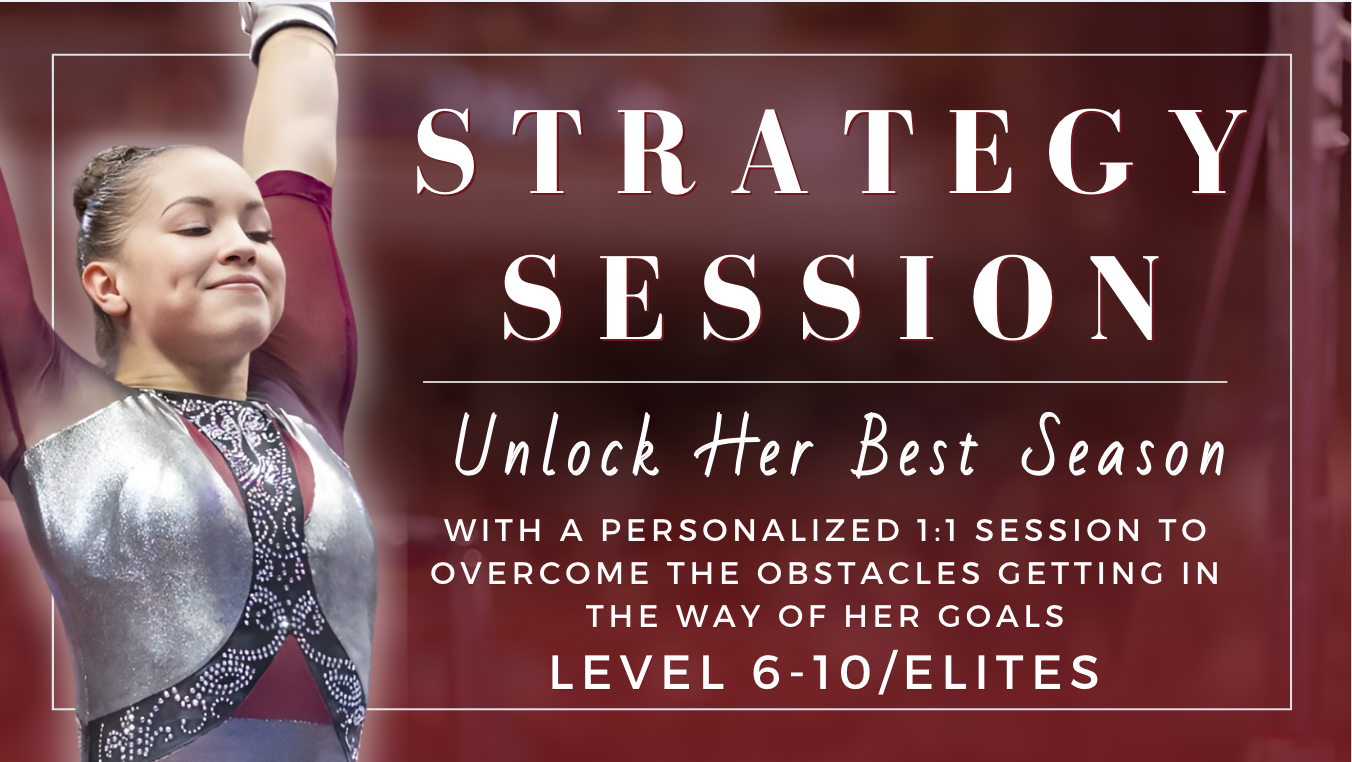
Get Started With a FREE 1:1 Strategy Session
In this free 1:1 strategy session, your gymnast will clarify her goals for the year and determine what it will take to reach them and what will get in her way. Then we will discuss if she is a good fit for our mental performance coaching and training program and the next steps with you both.
Regardless of if you join us, you will walk away with our before and after goal setting process she can use again and again to get crystal clear on her goals and her path to reach them.
Free Training Clinic for Compulsory Gymnastics Parents!
The Proven 4-Step Mindset Method Your Gymnast Needs to Unlock Her Full Potential in the Gym and Out on the Competition Floor… So She Can Take Her Gymnastics to the Next Level!
Click the button below to get the parent training clinic every gymnastics mom needs to help their gymnast finally believe in themselves.